RWA Handbook
Regulations Mapping
Understand RWA regulatory frameworks, legal obligations, compliance steps, global policy changes and what builders must do to launch safely.
RWAs require more than just clean code, they demand a compliance-first mindset, because these tokens carry real legal obligations. Over the past year and a half (mid-2024 to November 2025), regulators around the world have stepped up enforcement and clarified their rulebooks. The result? Stricter expectations, but also clearer paths for teams that want to build responsibly.
In this section, we cut through the noise and turn global regulations into something builders can actually use: simple breakdowns by region, a December 2025 milestone tracker, updated asset-type classifications, and a practical founder checklist. The goal is to help you answer the core questions that matter, who regulates you, what needs registration, how your token will be classified, and what minimum steps you need to avoid getting shut down on day one.
Enforcement is also getting real. The EU’s MiCA regime has already issued over €540M in penalties, Singapore’s MAS has rejected every overseas-facing DTSP application, and the U.S. SEC and CFTC are now coordinating tokenization crackdowns under a new joint framework. Builders need to be prepared, but the path forward is clearer than ever.
Disclaimer !! This section is meant to guide you, not replace professional legal advice. Regulations are moving fast, MiCA has been fully enforceable since December 30, 2024, the GENIUS Act (July 2025) reshaped U.S. stablecoin oversight, and global alignment through IOSCO and FATF is picking up pace. Make sure you speak with qualified legal counsel for anything specific to your project or jurisdiction.
Regulatory classification is closely tied to the token standard you use, ERC-3643's on-chain identity checks exist largely to satisfy the obligations mapped out below. Tokenization 101 covers the same ground in a guided flow, asset class, chain, standard, and a regulation-mapping step with jurisdiction-specific exemptions, if you want a faster first pass before working through the full breakdown here.
Region-Based Breakdown
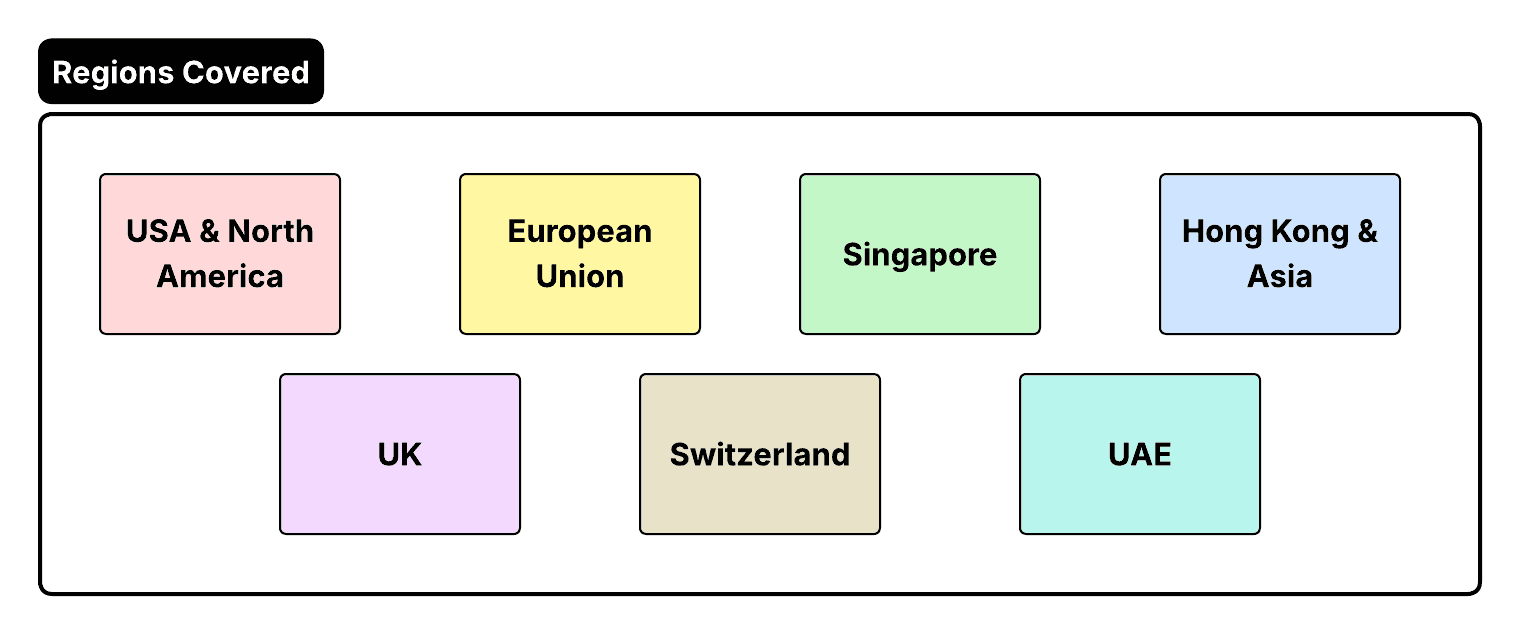
We break down the five key jurisdictions (plus three emerging hubs) into uniform templates. Each covers the core: oversight bodies, licenses that bite, security triggers, and project must-dos. These reflect regulatory snapshots as of November 2025, cross-reference with local experts before filing.
USA & North America
The SEC (securities and any tokenized assets that resemble investment contracts), the CFTC (commodities, derivatives, and tokenized collateral), and FinCEN (AML/KYC obligations for money-service activities). SEC–CFTC coordination is increasing through joint statements and shared roundtables, and both agencies are preparing aligned enforcement actions targeting token misclassification.
Key Licenses:
- Broker-Dealer (SEC/FINRA - for trading tokenized securities)
- ATS (Alternative Trading System for secondary-market execution)
- RIA (for advisory functions)
- MSB (FinCEN for money transmission)
- Federal Stablecoin Issuer (under the GENIUS Act)
- State money-transmitter licenses (unless exempt under the GENIUS Act)
Stablecoin Regulatory Clarity (GENIUS Act, July 2025)
The Guiding and Establishing National Innovation for U.S. Stablecoins (GENIUS) Act creates a federal framework specifically for payment stablecoin issuers, establishing a separate category outside SEC/CFTC jurisdiction. The main provisions now in effect:
Eligible Issuers: Limited to federally chartered banks, OCC-supervised non-banks, and state-chartered institutions with federal approval. Pure fintechs, DAOs, or crypto-native platforms cannot issue payment stablecoins without a banking partner.
Reserve Requirements: 100% backing with strictly defined high-quality liquid assets:
- U.S. cash
- U.S. Treasury bills with ≤ 93-day maturity
- Eligible taxable or tax-exempt money market mutual funds. Weekly attestations are required, and monthly public reserve disclosures are mandatory.
Prohibited Features: No interest, no yield, no fees tied to holding, and no algorithmic supply adjustments. Pure 1:1 payment instruments only.
Custody & Segregation: Reserves must be held with a qualified custodian (FDIC-insured). Customer funds are fully segregated and prioritized in insolvency, significantly stronger protection than what most crypto platforms currently offer.
AML/CFT Obligations: Issuers are treated as federal financial institutions under the Bank Secrecy Act. They must maintain full customer identification, sanctions screening, and SAR programs comparable to traditional banks.
Technical Requirements: Issuers must support the ability to freeze, seize, or burn stablecoins when legally required (e.g., sanctions or law-enforcement orders).
When a Token Is Treated as a “Security”?
Apply the Howey Test. Tokens representing money invested in a common enterprise with profits expected from others’ efforts, such as fractionalized RWAs, tokenized bonds, or real-estate shares, fall under SEC jurisdiction. Tokenized commodities (e.g., gold) lean toward CFTC oversight, while hybrid structures can trigger both agencies. Any non-payment stablecoin (yield-bearing, reward-based, or algorithmic) remains outside the GENIUS framework and stays within securities or commodity rules.
CFTC Tokenized Collateral Initiative (September 2025, Pending)
The CFTC has launched a Tokenized Collateral and Stablecoins Initiative seeking public comment. No final rules yet. The initiative builds on GMAC 2024 recommendations and aims to allow blockchain-based collateral in derivatives margin frameworks. Currently eligible collateral categories include government debt, gold, and select corporate securities. RWA builders working on collateral infrastructure should monitor CFTC updates on valuation standards, custody interoperability, and settlement-finality requirements.
Minimum Requirements for RWA Projects
Classification: Conduct a Howey analysis or seek an SEC no-action letter. For commodity-like structures, obtain CFTC feedback.
Registration: Choose the appropriate path:
- Form D (Reg D private offering)
- Form A-1/A+ (Reg A crowdfunding)
- Full registration
- Reg S (international issuances)
Custody: Use qualified custodians (e.g., Coinbase Custody or traditional banks with digital-asset divisions).
Disclosure: Prepare a PPM with detailed risk disclosures, underlying-asset information, custody arrangements, and investor rights.
AML/KYC: Implement FinCEN-compliant systems. The Travel Rule (for transfers >$3K) is functionally enforced even as final rulemaking continues.
Tokenized Collateral: If relevant, follow the CFTC’s 2025 public-input standards and evolving guidance.
European Union
ESMA handles EU-wide coordination, while national competent authorities (NCAs) such as BaFin (Germany), AMF (France), CNMV (Spain), and the FCA (UK post-Brexit) manage local supervision. MiCA (Markets in Crypto-Assets Regulation) governs all non-security crypto assets across the EU. Stablecoin requirements took effect June 30, 2024, and full enforcement for token issuance and CASP licensing began December 30, 2024.
Key Licenses:
- CASP (Crypto-Asset Service Provider) licensing for trading, custody, and exchange activities under MiCA
- MiFID II authorization for any token that qualifies as a financial instrument (e.g., shares, bonds, fund units)
- ART Issuer Authorization for asset-referenced tokens (requires ESMA approval)
- EMT Issuer Authorization for e-money tokens (requires ESMA approval)
MiCA Enforcement & White Paper Deadlines
- December 30, 2024: Full MiCA enforcement for CASPs and token issuers began.
- December 23, 2025: New MiCA white paper technical standards (Commission Implementing Regulation 2024/2984) became mandatory. All existing token white papers must be updated to meet format and disclosure requirements. Major EU exchanges issued compliance notices and began removing non-compliant tokens by October 2025.
- July 1, 2026: End of transitional relief. CASPs and issuers operating before December 30, 2024, must be fully compliant. Some Member States may apply shorter transition periods.
White Paper Requirements
White papers must follow ESMA standardized templates by token category (ART, EMT, other crypto-assets) and be published in machine-readable formats (.pdf, .xls). Required disclosures include:
- All material risks
- Reserve/backing details for ARTs/EMTs
- Smart contract audit results
- Governance, redemption rights, and operational processes
Non-compliant issuers risk immediate de-listing from regulated exchanges.
Token Classification Under MiCA
- Asset-Referenced Tokens (ARTs): Pegged to a basket of assets (commodities, equities, currencies). Must maintain auditable reserves (risk-based, typically >2%) and obtain ART issuer authorization + white paper approval.
- E-Money Tokens (EMTs): Must be backed 1:1 with euro-denominated funds and issued only by authorized e-money institutions. Require issuer authorization + white paper + customer-fund protections.
- Other Crypto-Assets: Any token outside ART/EMT definitions. Require a MiCA white paper and CASP licensing, but no separate issuer license.
Minimum Requirements for RWA Projects
- Classification: Determine if the token is a security (MiFID II) or a crypto-asset (MiCA).
- Securities - MiFID II + Prospectus Regulation
- Crypto-assets - MiCA white paper + CASP licensing
- White Paper: File with the home-state NCA. Becomes effective after 20 working days, then recognized EU-wide.
- CASP Licensing: Required for any exchange, custody, or execution activity.
- Reserve Audits: ART issuers must perform quarterly NAV attestations and annual full audits by accredited auditors.
- KYC/AML: Comply with AMLD5/6 requirements, including Travel Rule implementation and customer-asset segregation under MiCA Article 80.
- Custody: Use EU-licensed custodians (banks or MiFID II custodians) and ensure appropriate insurance coverage.
Singapore
The Monetary Authority of Singapore (MAS) regulates digital-asset activity through the Payment Services Act (PSA), Securities and Futures Act (SFA), and Financial Advisers Act (FAA). The Digital Token Service Provider (DTSP) framework expanded on June 30, 2025, accompanied by strict enforcement and a notably conservative regulatory posture.
DTSP Licensing & June 30, 2025 Enforcement
MAS has set an extremely high threshold for DTSP licensing. The regulator has explicitly stated it will generally not issue a licence to providers targeting overseas users. Key enforcement elements:
- Overseas-Only Providers: Are not eligible for DTSP licenses. Existing overseas-facing operators had a hard shutdown deadline of June 30, 2025, no transitional period, no grandfathering.
- Singapore-Focused Services: Businesses serving Singapore customers are already covered under PSA (payments), SFA (securities), or FAA (advisory). These do not need a separate DTSP license.
- Licensed DTSPs: Must maintain SGD 250K base capital, employ a Singapore-based compliance officer, conduct annual audits, implement enhanced AML/CFT controls per MAS Notice FSM-N27 (revised July 2025), and segregate client assets.
- Foreign-Facing Services: May be exempt only if they can prove they have no meaningful Singapore customer base. MAS requires documentation and performs rigorous verification.
Key Licenses
- CMS (Capital Markets Services) license for securities dealing or advisory under SFA
- DPT (Digital Payment Token) license for non-security tokens under PSA
- No CASP-equivalent license required if the activity is already regulated under PSA/SFA/FAA
When a Token Is Treated as a “Security”?
A token is considered a security under the SFA if it meets Singapore’s definition of an investment contract, broadly aligned with Howey (investment + common enterprise + profit expectation). Tokenized RWAs, such as private credit or fractional real estate, generally qualify. Pure payment tokens or commodity-backed tokens may fall under PSA instead. MAS has already issued enforcement actions in 2025 against unregistered RWA-style offerings.
Minimum Requirements for RWA Projects
- Classification: Determine whether the token is a security (SFA) or a payment token (PSA).
- Licensing:
- DPT license under PSA for non-security tokens
- CMS license under SFA for securities issuance, dealing, or advising
- Capital & Governance: Maintain SGD 250K capital, appoint a Singapore-based compliance officer, and ensure board-level supervision.
- AML/CFT: Implement full Travel Rule compliance and apply MAS’s customer-segmentation rules for retail vs. professional investors.
- Custody: Segregate client assets and use MAS-recognized custodians (local banks or licensed custody providers).
- Audits: Conduct annual external audits and submit quarterly compliance reports to MAS.
Hong Kong & Asia
The Securities and Futures Commission (SFC) and the Hong Kong Monetary Authority (HKMA) jointly oversee Hong Kong’s virtual-asset ecosystem. The SFC’s ASPIRe Roadmap (February 2025) and its November 2025 expansion form one of the most advanced regulatory frameworks in Asia. Other active hubs include VARA (Dubai/ADGM) and the Saudi Market Authority (SMA), but Hong Kong remains the primary regional benchmark.
SFC Licensing & Expansions (Feb–Nov 2025)
The SFC’s five-pillar ASPIRe Roadmap set the strategic direction in February 2025, followed by major licensing and product expansions effective November 3, 2025:
- Type 1 (Securities Dealing): Brokerage and dealing in tokenized securities
- Type 7 (Automated Trading Services): Algorithmic and matching-engine operations
- VATP (Virtual Asset Trading Platform): Primary licensing framework for VA exchanges
- VATP Custody Provider (New in Nov 2025): Can offer custody for tokenized securities and virtual assets even if the assets are not traded on their own platform (subject to phase-2 approvals for certain categories)
Token Admission Requirements (Nov 2025 Updates)
- Professional Investors: The previous 12-month track record requirement is now waived for all virtual assets (including stablecoins). However, VATPs must still conduct due diligence under VATP Guideline 7.6.
- Licensed Stablecoin Issuers: Stablecoins issued under the upcoming Stablecoin Ordinance can be offered to retail investors immediately, with no track-record requirement.
- Tokenized Securities: No 12-month track record ever applied; retail access is allowed upon successful due-diligence clearance.
- Risk Disclosure: VATPs must clearly label which professional-only assets lack a track record and must provide enhanced risk warnings on their website/app interfaces.
Shared Liquidity Initiative (Nov 2025)
Licensed VATPs may now share order books with overseas affiliated platforms, allowing:
- deeper market liquidity,
- reduced fragmentation, and
- faster settlement workflows for institutional clients.
Custody & Digital Asset-Related Investment Products (Nov 2025)
VATPs can now:
- Distribute Digital Asset-related Investment Products (crypto ETFs, tokenized-securities funds, etc.) in compliance with SFC product codes.
- Open trust/client accounts with recognized custodians to support distribution.
- Provide custody for tokenized securities and virtual assets not listed on their own platform, subject to case-by-case SFC approval and asset-class limitations.
When a Token Is Treated as a “Security”?
Under the Securities and Futures Ordinance (SFO), a token counts as a security if it represents:
- ownership,
- profit rights, or
- participation in a collective investment scheme.
Tokenized RWAs, fractional real estate, bonds, and fund units clearly qualify. Pure commodities may fall under futures rules instead.
Minimum Requirements for RWA Projects
- Licensing: Secure the appropriate authorization, Type 1, Type 7, or VATP.
- Custody: Work with SFC-licensed custodians and meet all segregation requirements.
- Investor Classification: Implement full retail/professional suitability checks and onboarding rules.
- Risk Disclosures: Provide Hong Kong-specific disclosures, including track-record transparency where required.
- Audits & Attestations: Conduct annual external audits, quarterly NAV attestations, and submit required compliance filings to the SFC.
- Phase-2 Assessment: Complete the SFC’s phase-2 operational resilience review if offering custody for assets not traded on your own platform.
Global Standards & Emerging Hubs
- FATF (Financial Action Task Force): Global AML/CFT standards for VASPs, including Travel Rule alignment and sanctions screening.
- IOSCO (International Organization of Securities Commissions): Securities principles, June 2025 Tokenization Report covering custody standards, investor protection, and cross-border market infrastructure.
- Basel Committee: Bank-level crypto risk, collateral eligibility, and custody frameworks.
Key Standards
- VASP Registration: FATF Travel Rule implementation (EU effective Dec 30, 2024; global rollout 2025–2026).
- Custody & Audit: IOSCO principles on segregation, insurance, third-party attestations, and operational resilience.
- Interoperability: DLT settlement and messaging standards for cross-chain trading and multi-chain asset issuance.
Emerging Hubs: UK, Switzerland, UAE
United Kingdom (Post-Brexit)
Regulators: FCA (Financial Conduct Authority), with HM Treasury oversight.
Fund Tokenization (Oct 2025 Consultation CP25/28): The FCA introduced proposals enabling authorized funds (UCITS/NURS) to tokenize their unit registers on DLT. Two models under consultation:
- Blueprint Model (Stage 1): Fund units recorded on blockchain, all other functions (custody, depositary, asset holding) remain unchanged.
- Direct-to-Fund Model: Investors interact directly with the fund using DLT, reducing intermediaries and distribution costs. Still under review.
Securities Tokenization: The FCA applies existing securities law without creating a token-specific regime. Tokenized shares/bonds follow standard FCA Handbook requirements (COBS, MiFID-equivalent), prospectus rules, and disclosure obligations. Issuers may rely on existing exemptions—no separate tokenization license required.
Minimum Requirements for UK RWA Projects:
- Fund Tokenization: FCA authorization under FUND rules, submit DLT registry technical plan.
- Securities: Follow prospectus, custody, and intermediary obligations within current exemptions.
Switzerland
Regulators: FINMA and SIX.
DLT Act (2021) & FINMA Guidance: Switzerland offers one of the most mature, DLT-native regulatory environments. FINMA categorizes tokens by economic function:
- Asset Tokens: Tokenized shares, bonds, or real-world assets; treated as securities. Fall under FinSA and FinIA, requiring securities-firm licensing for issuance/trading.
- Utility Tokens: Not securities if they (i) provide digital access or usage rights only, and (ii) are fully usable at issuance. If investment features exist, they become securities.
- Payment Tokens: Treated as foreign-exchange/payment instruments, lighter oversight.
Ledger-Based Securities (DLT-Securities): Recognized under Swiss Code of Obligations (Art. 907h+), giving DLT-based securities identical legal status to traditional ones. SIX SDX is the world’s first fully licensed DLT exchange + settlement system (FINMA approval 2023).
Minimum Requirements for Swiss RWA Projects:
- Classification: Asset token (security), utility, or payment token.
- Licensing: Asset tokens require securities-firm registration or partnership with a licensed entity.
- Custody: FINMA-compliant DLT custody (insurance, audits, resilience review).
- Issuance: File with FINMA for novel constructs; standard tokenization generally permitted under existing law.
UAE (ADGM & DIFC)
Regulators:
- FSRA (Abu Dhabi Global Market)
- DFSA (Dubai Financial Services Authority)
- VARA (Virtual Assets Regulatory Authority, Dubai)
ADGM Framework (FSRA): Operates under the unified FSMR rulebook. Technology-neutral treatment of digital securities. Requires FSP (Financial Services Permission) for:
- Digital securities issuance
- Dealer/broker activities
- Custodial services
- Investment management
DIFC Framework (DFSA + VARA): Dual-regime approach:
- DFSA: Oversees investment tokens, security tokens (substance-over-form assessment).
- VARA: Oversees pure virtual assets (stablecoins, governance tokens, etc).
- ITL (Innovation Testing Licence): Regulatory sandbox for tokenization pilots; relaxed rules for 12 months, then conversion into full licensing.
Capital & Compliance Considerations:
- ADGM: Lower capital requirements, simplified onboarding, strong sovereign-wealth connections.
- DIFC: Global institutional access, high regulatory alignment, and established corporate partnerships (FinTech Hive).
Minimum Requirements for UAE RWA Projects:
- Jurisdiction Choice: ADGM for cost-efficient, sovereign-aligned builds; DIFC for institutional scale and global distribution.
- Classification: Determine whether the asset is a digital security (ADGM/DFSA) or a virtual asset (VARA).
- Licensing: Submit FSP/CAT/VARA applications with AML/KYC manuals, custody frameworks, and operational policies.
- Custody: Use UAE-licensed custodians or ADGM/DIFC-authorized entities.
- Compliance: AML/CFT adherence, annual audits, quarterly regulatory filings.
Token Classification Decision Tree
Use the following decision tree to quickly triage a token’s regulatory status across major jurisdictions. Start at the root and move down based on the token’s economic features and design

Asset-Type Mapping Matrix
This matrix gives you a simple way to understand how different RWA products are treated across major regions as of December 2025. Each row covers an asset type, and each column explains how regulators in that region typically classify it. Think of it as a quick triage tool: “If I'm building X asset in Y region, what rules am I likely dealing with?”
| Asset Type | USA | EU | Singapore | Hong Kong/Asia | Global Standards |
|---|---|---|---|---|---|
| Treasuries / Govt Bonds | Usually treated as securities (SEC). Tokenized versions fall under securities laws. Treasury-backed payment stablecoins may qualify under the GENIUS Act if fully backed and without yield. | Treated as financial instruments (MiFID II). Under MiCA, they can fall under ART/EMT rules if pegged to assets or fiat. | Considered DPTs if used like payments; securities under SFA if they involve yield. | Security classification if fractionalized; new HKMA guidance on treasury-backed stablecoins is emerging. | IOSCO liquidity guidance, FATF Travel Rule, and interoperability standards like ISO 20022/SWIFT apply. |
| Private Credit / Loans | Generally a security (Howey test). Often issued under Reg D. | Financial instruments under MiFID II; may fall under ART rules if backed by asset pools; AIFMD applies if fund-wrapped. | Security under SFA (CMS license needed). Exemptions available for small professional investor groups. | Treated as securities under SFO; SFC allows listing for professionals after checks. | IOSCO investor protection + FATF VASP rules; strong emphasis on credit-risk disclosures. |
| Equity / Shares | Clearly a security with SEC registration and ATS rules. Requires transfer agent and custody compliance. | MiFID II financial instrument; prospectus required above €100k; CASP custody rules apply. | Security under SFA; can be listed on SSX or sold privately. | Security under SFC Type 1; professional investor framework; custody must be licensed. | IOSCO governance rules + Basel segregation standards; settlement via ISO 20022/SWIFT. |
| Real Estate (Fractionalized) | Typically a security (Howey). Requires detailed disclosures like appraisals and lease terms. | Treated as securities or potentially ARTs if stability is linked to properties; local real-estate laws also matter. | Security under SFA; foreign ownership/property rules may apply; CMS needed. | Security under SFO with CIS rules; mortgage-related HKMA guidance and stamp duty apply. | IOSCO custody/title guidance, FATF AML standards, and UNCITRAL cross-border title rules. |
| Commodities (Metals, Agri) | Commodity under CFTC rules; tokenized collateral work is ongoing. | Considered commodities, not financial instruments, unless structured as ARTs under MiCA. | Treated as commodities; may fall under DPTs or futures depending on structure. | Commodity/futures under HKMA/SFC; lighter rules if not derivative-based. | FATF AML rules for high-value goods; IOSCO guidance on preventing market abuse. |
| Art / IP / NFTs | Mostly not securities if collectibles with no yield; becomes a security if revenue-sharing or profit expectations exist. | Not usually financial instruments unless bundled with rights. MiCA can apply for large fungible-like collections. | Unclear; assume security if there’s an investment angle. | Case-by-case: can be securities if income or dividends are implied. | FATF AML focus due to laundering risks; limited global harmonization. |
| Insurance / Derivatives | Derivatives under CFTC rules; can be securities depending on structure. Swap-dealer requirements possible. | Derivatives under MiFID II/MiFIR; strong disclosure requirements. | Derivatives under SFA; separate insurance regulation. Dual oversight is common. | Derivatives or insurance products; usually for professional investors only. | IOSCO derivative standards, FATF risk rules, and Basel collateral guidance. |
| Marketplace / Exchange Tokens | Treated as securities if they offer profit sharing or governance rights. Platforms may require ATS or broker-dealer licensing. | Often a financial instrument if revenue-sharing; utility tokens fall under MiCA. CASP rules apply for exchanges. | Considered utility tokens unless they share profits; exchange-like behavior triggers SFA/CMS licensing. | Utility if no profit-sharing; otherwise security with VATP rules. | FATF custody rules + IOSCO exchange principles; no global uniform crypto-exchange regime yet. |
Practical Founder Checklist
This section provides a universal, jurisdiction-agnostic minimum viable compliance roadmap. Follow each step sequentially and adapt for your target regions and asset types.
Preamble: The 5 Critical Compliance Pitfalls
Before executing any build, be aware that these mistakes consistently lead to regulatory intervention or project failure:
- Incorrect token classification - misapplied regulatory framework - SEC/CFTC enforcement. Classification tests (Howey, MiFID II, SFA) are based on underlying economic substance, not terminology. A token labeled “utility” may still be a security if it conveys profit rights or investment characteristics. Determine classification before product design.
- Launching without a dedicated SPV - custody risk - investor claims during insolvency. Without a bankruptcy-remote entity, customer assets may be treated as unsecured claims. Use a separate legal wrapper (e.g., Delaware LLC, Luxembourg SAS, Cayman SPV) to isolate risk.
- Failing to implement AML/Travel Rule obligations - fines and service shutdowns. Identity verification, sanctions screening, and Travel Rule messaging are mandatory across major jurisdictions (AMLD5 in the EU, FinCEN in the U.S., MAS Notice FSM-N27 in Singapore). Non-compliance leads to significant penalties and loss of licensure.
- Insufficient custodian due diligence - issuer liability for third-party AML failures. Under MiCA, the GENIUS Act, and the SFA, issuers share liability for custodian misconduct. Only work with licensed, audited custodians with demonstrable compliance programs.
- Using non-localized disclosures - investor rescission rights + regulatory penalties. A U.S. Reg D PPM is not a MiCA whitepaper, and neither substitutes for an SFA offering document. Each jurisdiction requires its own disclosures, risk statements, and regulatory language.
Checklist Flowchart

Step 1: Classify the Token
Objective: Determine whether the token is a security, commodity, utility, or hybrid instrument in each jurisdiction.
Actions:
- United States: Apply the SEC Howey Test. Use FinHub guidance or seek informal feedback through a no-action letter request.
- European Union: Distinguish between MiFID II financial instruments, MiCA crypto-assets, and ART/EMT categories. Use ESMA’s classification guidance or consult your NCA.
- Singapore: Apply the SFA investment-contract test (mirrors Howey). Borderline cases should request a MAS pre-approval letter.
- Hong Kong: Apply the SFO definition of “securities,” including profit/dividend rights and CIS structures. Engage the SFC’s FinTech Contact Point for early feedback.
Deliverable: A written classification memo for each jurisdiction. When uncertain, adopt the more conservative interpretation and treat the token as a security.
Step 2: Establish the SPV / Legal Wrapper
Objective: Create a bankruptcy-remote issuer to insulate on-chain activity and investor assets.
Actions:
- U.S.: Delaware LLC for issuance; Cayman SPV for offshore investors.
- EU: Luxembourg SAS or SE for EU-wide recognition; alternatives include SARL (France), GmbH (Germany).
- Singapore: Singapore Pte Ltd.
- Hong Kong: Company limited by shares.
- UAE: ADGM or DIFC free-zone company.
Key Provisions:
- Explicit asset segregation and bankruptcy-remote clauses.
- Board approvals for token issuance and operational delegation.
- Annual audit requirements (quarterly for listed RWA structures).
Step 3: Implement KYC/AML Controls
Objective: Build a compliant identity verification and sanctions-screening framework aligned with FATF, AMLD5, FinCEN, and MAS standards.
Actions:
- Vendor Selection: Integrate a compliance platform (Chainalysis, Sumsub, Onfido, Mitek).
- Investor Tiers:
- Retail: Basic KYC.
- Accredited/Professional: Enhanced due diligence + source-of-funds checks.
- Institutional: OFAC/EU sanctions + beneficial-ownership verification.
- Travel Rule Compliance:
- Share originator and beneficiary details.
- Thresholds: EU >€1,000; U.S. >$3,000; Singapore SGD 500+ (proposed 2026).
- Sanctions Screening: Real-time checks across OFAC, EU, MAS lists.
- Recordkeeping: Maintain records for five years per AMLD5/BSA requirements.
Step 4: Custodian Selection & Audit Preparation
Objective: Choose a licensed custodian and implement ongoing audit and attestation processes.
Actions:
- Select Custodian:
- U.S.: Bank-backed custodians (Fidelity, BNY Mellon, State Street) or SOC 2-certified digital custodians.
- EU: MiFID II custodians or qualified banks.
- Singapore: MAS-recognized custodians (DBS, UOB).
- Hong Kong: SFC-approved custodians.
- UAE: ADGM/DIFC-licensed custodians.
- Custody Agreement: Must define asset segregation, insurance levels, wallet architecture, fee schedules, and loss-allocation terms.
- NAV Attestation: Quarterly independent NAV attestation for all asset types.
- Annual Audit: SOC 2 Type II / ISO 27001 audits by a recognized firm.
- ART/EMT issuers (EU) require additional reserve audits.
- Insurance:
- Custody insurance (cyber, theft, fraud) typically 100–150% AUM.
- E&O insurance for operational risk.
- Optional smart-contract risk coverage.
Step 5: Verify Licensing Requirements
(Executed in parallel with Step 3)
Objective: Map and initiate all required regulatory applications.
United States:
- Reg D private offering (fastest).
- Reg A+ (retail access, SEC qualification required).
- Full registration (S-1/S-3).
- GENIUS Act stablecoin issuers require a bank charter or state MTL.
European Union:
- MiCA CASP authorization (for custody/exchange).
- MiFID II authorization (if security).
- ART/EMT issuer approvals (ESMA + NCA).
Singapore:
- CMS license (securities).
- Exemptions for <50 accredited investors.
Hong Kong:
- Type 1 or Type 7 license.
- VATP licensing for virtual-asset platforms.
UAE:
- ADGM/DIFC FSP or ITL (pilot).
Step 6: Prepare Disclosures & Investor Agreements
Objective: Draft compliant, jurisdiction-specific documentation for issuance, offering, and investor onboarding.
U.S. (Reg D / A+):
- Form D, PPM, SAFT (if applicable).
EU:
- MiCA-compliant whitepaper (ITS-aligned).
- MiFID II prospectus (if financial instrument).
- KIID for fund structures.
Singapore:
- SFA offering document with risk, suitability, and custody disclosures.
Hong Kong:
- SFO offering document; professional-investor suitability analysis; auditor statements where required.
Investor Agreements:
- Subscription Agreement, Custody Agreement, AML acknowledgements, jurisdiction-specific risk notices.
- Define reporting cadence (quarterly NAV, annual financials).
Step 7: Data Protection & Tax Compliance
Objective: Implement global data-privacy and tax-reporting obligations.
Data Protection:
- GDPR (EU), CCPA (U.S.), PDPA (Singapore), PDPO (Hong Kong) compliance.
- Data-processing agreements with custodians and vendors.
Tax Reporting:
- FATCA (U.S.) and CRS (OECD) reporting for cross-border investors.
- IRS capital-gains treatment and annual Forms 8949/1099 for U.S. investors.
- Integrate tax reporting with custodian APIs where available.
Step 8: Final Legal Review & Soft Launch
Objective: Validate all compliance steps; conduct a controlled launch with professional investors.
Pre-Launch Checklist:
- Token classification completed.
- SPV established; board resolutions signed.
- AML/KYC systems operational.
- Custody agreement executed.
- NAV attestation process established.
- Licensing applications submitted.
- Disclosure packages finalized.
- Data-privacy and tax frameworks implemented.
- Insurance policies in place.
Soft Launch: Limit to professional or accredited investors for initial testing. Monitor settlement, KYC triggers, disclosures, and operational workflows. Incorporate feedback before full public launch.
Compliance Calendar & Key Deadlines (2026–2027)
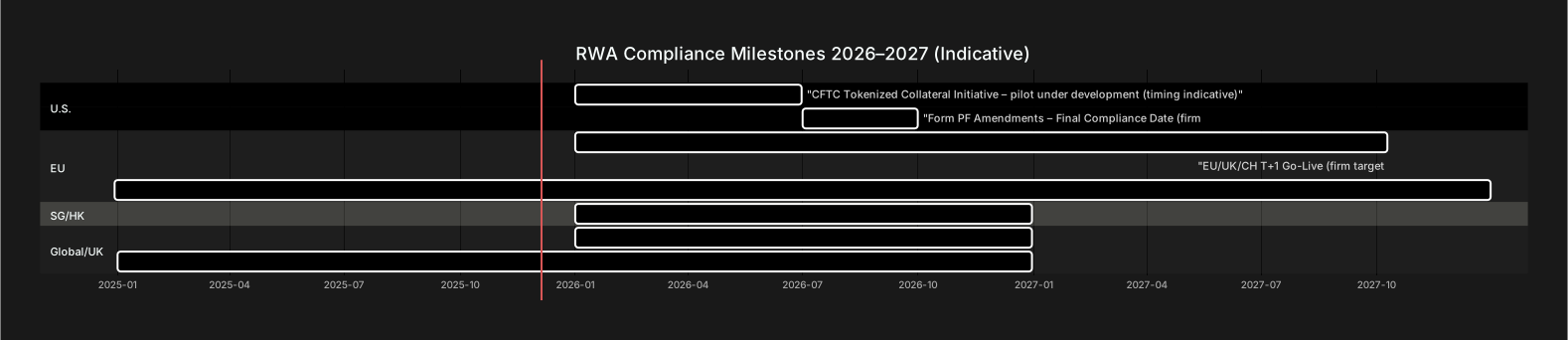
The following timeline combines confirmed regulatory milestones with projected implementation windows based on ongoing consultations, technical-standards workstreams, and regulator guidance. Dates marked “indicative” or “expected” reflect current industry assumptions and may shift as final rules are published.
Key Dates and Regulatory Milestones
| Date | Region | Requirement (Status) | Impact (Example / Indicative) |
|---|---|---|---|
| 2026 (indicative) | U.S. | CFTC tokenized-collateral and stablecoin initiative potential limited pilot (timing TBC) | Select RWA and stablecoin issuers may gain access to early collateral-pilot programs, subject to CFTC action and eligibility criteria. |
| Q2–Q3 2026 | U.S. | Form PF amendments implementation period ahead of 1 Oct 2026 firm compliance date | Private fund advisers must upgrade systems to capture, classify, and report digital and tokenized assets within Form PF workflows. |
| 2026–Q3 2027 (indicative) | EU/UK/CH | T+1 market-infrastructure preparation and testing phase | Brokers, asset managers, and RWA platforms adapt clearing, settlement, and collateral processes to support T+1 cycles across EU/UK/CH markets. |
| 11 Oct 2027 | EU/UK/CH | T+1 settlement go-live (confirmed target) | T+1 becomes the market standard, affecting operational timelines for cash and tokenized securities, including issuer processes and custody workflows. |
| To 1 Jul 2026 | EU | MiCA CASP transitional period for firms operating under national regimes (firm; MS discretion applies) | Existing CASPs may continue under national licenses until 1 Jul 2026 unless the Member State opts out or shortens the transitional regime. |
| To 31 Dec 2027 | EU | MiCA white-paper grandfathering for certain pre-existing crypto-assets (firm) | Issuers with eligible assets admitted before 30 Dec 2024 must finalize MiCA-compliant white papers, disclosures, and governance processes by end-2027. |
| 2025–2026 (indicative) | UK | UK fund-tokenization consultations and guidance (timing subject to FCA workstreams) | UK-authorized funds explore tokenized-unit issuance structures under evolving FCA guidance, with implementation pathways expected to firm up throughout 2026. |
| 2026 (indicative) | SG/HK | Continuing enhancements to AML/Travel Rule and VATP supervisory frameworks | RWA issuers and exchange platforms should expect heightened AML expectations, revised Travel Rule thresholds, and stricter custody/operational-resilience standards. |
Edge Cases & Jurisdictional Pitfall
Fractional Real Estate RWAs (United States)
- Issue: Fractional property tokenization typically triggers dual oversight: real-estate regulation (FIRPTA, state land statutes) and federal securities regulation (Howey Test, Reg D/Reg A+).
- Regulatory Framework: Fractionalized interests generally require compliance with Regulation A+ or a full Form S-1 registration. Some states (e.g., California) additionally require registration with state real-estate commissions.
- Compliance Burden: Dual registration (SEC + state), property-specific disclosures (title records, encumbrances, insurance), and FIRPTA withholding obligations for foreign investors. Legal and regulatory costs typically range from $100,000–150,000.
Tokenized Bond Funds (European Union)
- Issue: Tokenized bond funds fall under overlapping regimes, resulting in multi-layer obligations: AIFMD, MiFID II, and MiCA.
- Regulatory Framework:
- Fund managers require AIFM authorization.
- The underlying bonds fall under MiFID II and require a prospectus.
- Tokenized wrappers may require a MiCA white paper unless classified strictly as financial instruments.
- Compliance Burden: Custodians must satisfy traditional UCITS/AIF depositary standards as well as MiCA CASP custody requirements. NAV calculations must reconcile DLT-based registers and off-chain CSD records.
- Critical Risk: Liability allocation must be clearly defined in the event of DLT failure (e.g., smart-contract malfunction, chain outage). Contracts should specify responsibility among the manager, depositary, and tokenization platform.
Art / IP Tokenization
- Issue: Regulatory treatment remains uncertain; art/IP tokens often fail to meet securities exemptions.
- Regulatory Framework:
- If tokens involve profit-sharing, dividends, or investment return expectations, the SEC is likely to classify them as securities under Howey.
- Pure collectible tokens without investment features may fall outside securities rules but are still subject to FATF high-value asset AML requirements.
- Compliance Burden: Plan for full securities compliance: prospectus, investor suitability checks, AML verification.
- Appraisal by certified art valuers is required.
- Insurance must cover authenticity, damage, fraud, and forgery.
Staking & Custody Services (United States / EU)
- Issue: Staking arrangements sit near the boundary of administrative service vs. yield-bearing investment, making classification sensitive.
- Regulatory Framework (SEC Guidance May–Aug 2025):
- Protocol staking (custodian simply operates a node; rewards paid directly by protocol) → generally not a security.
- Liquid staking (receipt token issued, rewards passed through) → conditionally not a security, provided rewards are purely protocol-derived without enhancements.
- Restaking/multi-protocol staking → likely securities, due to the additional entrepreneurial effort and pooling structure.
- Compliance Burden: Rigorous documentation (node-selection memos, reward ledgers) to demonstrate an administrative-only role. Any discretionary action may trigger securities registration requirements. MAS, ESMA, and SFC apply similar tests with varying clarity.
Insurance-Linked Tokenization
- Issue: Tokenizing insurance structures (e.g., catastrophe bonds, parametric triggers) intersects insurance regulation, securities rules, and derivatives obligations.
- Regulatory Framework:
- U.S.: Insurance license required at the state level, plus potential Dodd-Frank derivatives oversight.
- EU: Governed by Insurance Distribution Directive (IDD), Solvency II, and securities rules.
- Compliance Burden: Dual licensing (insurance + securities), actuarial verification, capital requirements, and complex risk-transfer disclosures. Only a limited number of platforms have successfully navigated this regulatory stack.