Standards
ERC4626 Tokenized Vault Standard
Understand ERC4626 vaults, share accounting, yield distribution and how the standard enhances liquidity and cross-protocol integration in DeFi.
ERC4626, the Tokenized Vault Standard, defines a unified API for vaults that issue shares representing claims on an underlying ERC20 asset. For Real World Asset (RWA) protocols, this standard is especially valuable, vaults can express fractional ownership in tokenized Treasuries, real estate, commodities, or other off-chain collateral while maintaining a predictable, interoperable interface for deposits, withdrawals, and share accounting.
Before ERC4626, each yield-bearing protocol implemented its own vault logic, creating integration silos, inconsistent accounting models, and duplicated audit costs. ERC4626 resolved this by introducing a consistent framework for share conversions and asset management. For RWA builders, the standard provides a clean abstraction layer that supports off-chain custody flows, such as SPV attestations, oracle-fed NAV updates, or delayed settlement mechanics, while preserving seamless on-chain liquidity for shares.
A key design principle is black-box accounting, the vault exposes standardized preview and accounting functions without revealing internal state transitions. This is well suited to RWA vaults where NAV may depend on off-chain data feeds or asynchronous settlement cycles, yet integrators like lending markets or aggregators still need reliable conversions.
ERC4626 has seen broad adoption across DeFi. Yearn Vaults implement it for yield strategies, while RWA platforms like Centrifuge and RealT use it to represent income-bearing real-world assets such as invoices or rental properties. In regulated environments, ERC4626 is often paired with ERC3643 for compliance gating (for example, investor eligibility) and ERC7518 for identity verification during redemptions or capital calls.
Use of ERC4626 in RWA Contexts
ERC4626 is the foundational standard for RWA vaults because it abstracts the complexity of fractionalizing and managing real-world assets into a clean, ERC20 compatible interface. While traditional DeFi vaults wrap liquid tokens like ETH for yield strategies, RWA vaults adapt the model to illiquid, regulated assets tokenized private credit, commercial real estate, commodities, or bond portfolios, where on-chain shares represent legally backed off-chain value held by custodians or SPVs.
Key Applications in RWA Development
Fractional Ownership and Liquidity Provision
Many RWAs are high-value and indivisible (for example, a ten-million-dollar building or a portfolio of private credit). ERC4626 allows developers to mint fungible shares proportional to deposits, unlocking fractional ownership and secondary-market liquidity.
- Implement
deposit/mintto accept inflows (often via ERC20 wrappers like USDC representing cash or T-bills). - Shares can trade freely, offering liquidity for assets that would otherwise be locked for years.
- Example: A real estate vault where shares automatically accrue rental income through periodic
totalAssets()updates pushed by off-chain oracles.
Yield Accrual and NAV Management
totalAssets() serves as the vault’s canonical valuation oracle. For RWAs, developers override it with NAV feeds that reflect:
- bond coupons
- rental income
- loan interest
- appraised asset values
Using trusted sources (Chainlink, RedStone, Pyth) ensures convertToAssets and convertToShares return accurate values, critical for compliance and for investor redemptions. Regulators increasingly expect transparent NAV reporting, and ERC4626 provides this without exposing internal accounting.
Redemption and Settlement Mechanics
RWA redemptions are inherently asynchronous, physical settlement layers (banks, custodians, transfer agents) cannot finalize instantly.
Patterns include:
withdraw/redeemqueuing- ERC7540 async settlement flows
- EIP-712 investor signed claims
- Proof-of-reserve checks before fulfillment
These guardrails prevent over-withdrawals and ensure vault solvency, especially for semi-liquid assets like private credit or T-bills.
Composability Across the RWA Stack
ERC4626 vaults plug directly into DeFi:
- Aave accepts vault shares as collateral
- Uniswap pairs can provide deep secondary liquidity
- Aggregators (Yearn/Steakhouse) route into 4626 vaults natively
For regulated RWAs:
- Pair with ERC3643 for investor eligibility gating
- Combine with ERC7765 for modular compliance
- Integrate identity proofs via ERC7518
This drastically reduces integration complexity—for example, a tokenized invoice vault can list its shares across borrowing markets without custom adapters.
This drastically reduces integration complexity—for example, a tokenized invoice vault can list its shares across borrowing markets without custom adapters.
Developer Advantages in RWA Builds
- Regulatory Alignment: The black-box accounting model hides off-chain custodian processes while preserving accurate previews for MiFID II/MiCA-aligned disclosures.
- Extensibility: Hooks (such as
_beforeDeposit) allow injecting RWA-specific logic i.e, pricing oracles, geofencing, or IPFS-pinned compliance policies. - Risk Isolation: Shares remain fully ERC20 compliant, vault pauses do not freeze wallet held assets.
- Upgrade Path: Older RWA wrappers can migrate into ERC4626 via adapters, preserving TVL and simplifying audits.
Ondo, Centrifuge, RealT, and several institutional RWA platforms rely on ERC4626 to scale vaults backed by Treasuries, real estate, or credit portfolios some exceeding a billion dollars in AUM. OpenZeppelin’s implementation offers a secure foundation, which teams customize for RWA nuances such as custody-fee accrual, bypass lists, or settlement delays.
To visualize the end-to-end flow in an RWA vault, the following sequence diagram captures the typical deposit - yield - redemption cycle. It illustrates how users interact with the vault, how the vault interacts with custodians and asset managers, and how off-chain NAV updates flow back on-chain through oracles. This representation is especially important for understanding asynchronous settlement, delayed redemptions, and NAV-driven share accounting in RWA systems.
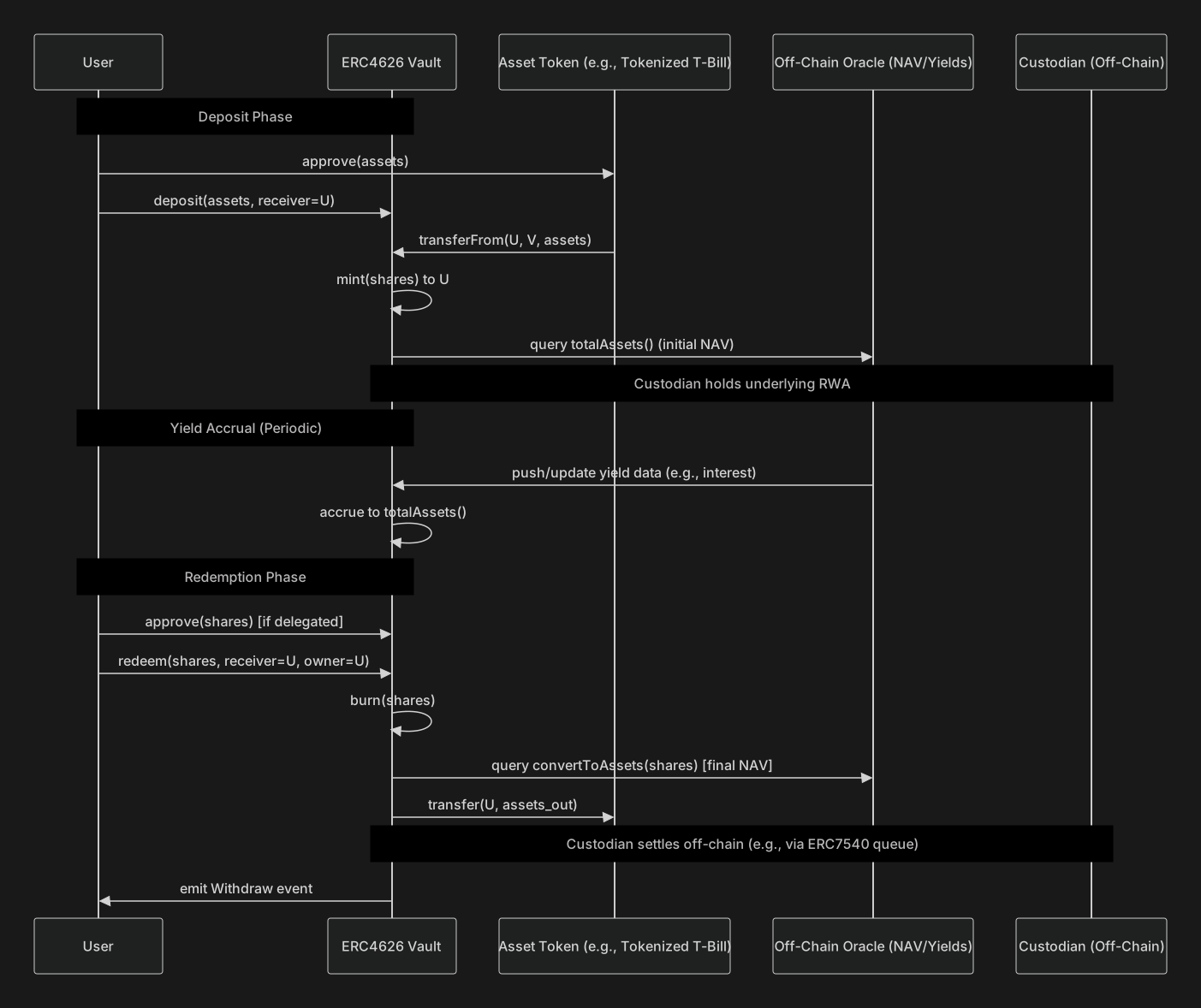
This diagram highlights how ERC4626 acts as the connective tissue between on-chain share accounting and off-chain asset realities. Deposits mint shares proportional to contributed value, totalAssets() captures real-world yield as NAV grows, and preview functions help manage slippage during redemptions. For illiquid RWA portfolios, the model can be extended with explicit redemption queues between the vault (V) and the custodian or SPV (C) to handle delayed settlement cycles.
Core Specification
An ERC4626 vault must implement the complete ERC20 interface for its share token, the fungible representation of a user’s proportional claim on the vault. Optional ERC2612 support enables permit-based approvals, a valuable enhancement for RWA use cases where institutions delegate share management without needing to pay gas.
In ERC4626, shares behave like any ERC20 token (balanceOf, totalSupply, transfers), while assets refer to the underlying ERC20 collateral managed by the vault. The standard enforces a clean separation between the two, ensuring predictable accounting and seamless integration across DeFi and RWA systems.
Key Definitions
- Asset the underlying ERC20 token the vault manages, for example, a tokenized Treasury bill, stablecoin, or credit note.
- Share the ERC20 token minted by the vault to represent proportional ownership of its underlying assets.
- Total Assets, the aggregate underlying value managed by the vault, is equal to the sum of principal, accrued yield, and adjustments for fees or losses.
- Convert Functions (
convertToShares,convertToAssets) Provide idealized, fee-agnostic conversions for UI, analytics, and oracle integrations. They represent the mathematical relationship between shares and assets. - Preview Functions (
previewDeposit,previewWithdraw, etc.) Provide near-exact estimates of expected outcomes, reflecting fees, rounding, or NAV changes, without executing state updates. These enable accurate transaction planning. - Rounding Rules ERC4626 mandates rounding in favor of the vault:
- Round down when issuing shares or assets, preventing dilution.
- Round up when requiring shares or assets, protecting existing participants. These rules ensure fair share distribution and discourage precision-based attacks.
The ERC4626 standard defines 17 required functions, organized by their roles in accounting, conversions, and I/O operations. Every function is implemented directly on the vault contract, ensuring a single source of truth for share accounting and asset movements. Below is the ABI-compliant interface, accompanied by developer notes covering edge cases, rounding behavior, and considerations specific to RWA vaults such as asynchronous settlement and NAV-driven updates.
1// SPDX-License-Identifier: MIT
2pragma solidity ^0.8.0;
3
4import "@openzeppelin/contracts/token/ERC20/IERC20.sol";
5
6interface IERC4626 is IERC20 {
7    // Asset queries
8    function asset() external view returns (address assetTokenAddress);
9    function totalAssets() external view returns (uint256 totalManagedAssets);
10
11    // Share conversions (ideal, no fees/limits)
12    function convertToShares(uint256 assets) external view returns (uint256 shares);
13    function convertToAssets(uint256 shares) external view returns (uint256 assets);
14
15    // Deposit limits and previews
16    function maxDeposit(address receiver) external view returns (uint256 maxAssets);
17    function previewDeposit(uint256 assets) external view returns (uint256 shares);
18    function deposit(uint256 assets, address receiver) external returns (uint256 shares);
19
20    // Mint limits and previews
21    function maxMint(address receiver) external view returns (uint256 maxShares);
22    function previewMint(uint256 shares) external view returns (uint256 assets);
23    function mint(uint256 shares, address receiver) external returns (uint256 assets);
24
25    // Withdraw limits and previews
26    function maxWithdraw(address owner) external view returns (uint256 maxAssets);
27    function previewWithdraw(uint256 assets) external view returns (uint256 shares);
28    function withdraw(uint256 assets, address receiver, address owner) external returns (uint256 shares);
29
30    // Redeem limits and previews
31    function maxRedeem(address owner) external view returns (uint256 maxShares);
32    function previewRedeem(uint256 shares) external view returns (uint256 assets);
33    function redeem(uint256 shares, address receiver, address owner) external returns (uint256 assets);
34
35    event Deposit(address indexed sender, address indexed owner, uint256 assets, uint256 shares);
36    event Withdraw(address indexed sender, address indexed receiver, address indexed owner, uint256 assets, uint256 shares);
37}
Detailed Function Breakdown (with RWA Developer Notes)
Below is a function-by-function explanation of the ERC4626 interface, including edge cases, rounding behavior, and RWA-specific implementation guidance for regulated assets, off-chain settlement, and NAV-driven valuation.
asset() external view returns (address)
Returns the address of the underlying ERC20 asset. In RWA vaults, this may be a tokenized Treasury bill, USDC (as cash-equivalent collateral), or a compliant wrapper token.
- This value is immutable, hardcode during construction to avoid governance-based asset swaps.
totalAssets() external view returns (uint256)
Reports the total value of assets managed by the vault after yield accrual, fees, and losses.
- RWA Integration: For NAV-based assets, override with oracle-fed valuations (Chainlink / RedStone / Pyth).
- Edge Case: Must correctly query rebasing assets (stETH-style tokens), or asset wrappers that hold interest-bearing positions.
convertToShares(uint256 assets)
Returns the ideal number of shares for a given asset amount (no fees, no slippage).
- Formula:
shares = assets * totalSupply / totalAssets, rounded down. - Usage: UI quoting, oracle integration, risk dashboards.
- RWA Note: Reflects pure NAV pricing, does not account for redemption delays or custody fees.
convertToAssets(uint256 shares)
Inverse of convertToShares, applying symmetric rounding.
- Ensures no precision-based arbitrage.
- RWA Note: Useful for NAV-based redemption disclosures in regulated markets.
maxDeposit(address receiver)
Returns the maximum amount of assets receiver can deposit.
- Return
uint256.maxfor “no limit.” - RWA Note: Enforce investor caps, jurisdiction restrictions, or temporary pauses due to regulatory flags.
previewDeposit(uint256 assets)
Simulates the shares to be minted from a deposit, including fees, but ignoring user limits.
- Discrepancies vs
convertToSharesreveal fee impact or slippage. - RWA Note: Useful for quote generation in redemption-queuing vaults or those with custody fees.
deposit(uint256 assets, address receiver)
Transfers asset tokens from the caller and mints shares to the receiver. Emits Deposit.
- Requires prior
approve()on the asset token. - Includes compliance hooks for KYC/AML evaluation.
- RWA Note:
- For illiquid assets (such as real estate and private credit): pair with ERC7540 asynchronous settlement.
- Trigger oracle checks for sanctions/residency validation.
maxMint, previewMint, mint
Mint-focused mirror of the deposit flow.
mint(shares)requires exact share quantity; assets pulled may vary post-fees.- RWA Use Case: Fund onboarding where investors receive a fixed number of shares based on a subscription agreement.
maxWithdraw, previewWithdraw, withdraw
Burns shares and returns a specific asset amount to the receiver.
- Supports delegated withdrawals via allowances.
- RWA Note:
- Add redemption queues to handle limited liquidity or T+ settlement cycles.
- Prevent over-withdrawal by enforcing NAV-consistent limits.
maxRedeem, previewRedeem, redeem
Burns a specific number of shares and returns the corresponding asset amount.
- Mirrors withdraw but are indexed by shares instead of assets.
- Emits
Withdraw. - RWA Note: Ideal for regulated funds that redeem based on fixed share amounts and variable NAV.
Events
event Deposit(address caller, address owner, uint256 assets, uint256 shares)event Withdraw(address caller, address receiver, address owner, uint256 assets, uint256 shares)
Reference Implementation
OpenZeppelin’s ERC4626 offers a mature, security-audited foundation for building tokenized vaults. The contract inherits from ERC20 and IERC4626, providing a clean extension surface for RWA-specific logic. Its design encourages minimal overrides while still supporting custom fee models, deposit caps, compliance layers, and strategy integration.
Key capabilities include:
- Inflation Attack Protection: The implementation prevents dilution attacks by enforcing meaningful initial deposits. Early minters cannot exploit low-supply corner cases to extract excess value from later users.
- Rounding Compliance: All conversions use
Math.mulDivfor precise, deterministic arithmetic that adheres to the ERC4626 requirement of rounding in favor of the vault. This eliminates subtle precision-drift exploits.
- Extensible Hooks: Lifecycle hooks such as
_beforeDeposit,_afterDeposit,_beforeWithdraw, and_afterWithdrawallow developers to embed RWA-specific functionality, NAV oracle checks, compliance gating, settlement status validation, or fee accounting, without modifying core logic.
- Flexible Inheritance Structure
ERC4626builds on OpenZeppelin’sERC20implementation, with optionalOwnableorAccessControllayers for regulated administration. This makes it straightforward to integrate custodial controls, upgrade pathways, or role-gated operations required in regulated RWA environments.
1import "@openzeppelin/contracts/token/ERC20/extensions/ERC4626.sol";
2import "@openzeppelin/contracts/token/ERC20/IERC20.sol";
3
4contract RWAVault is ERC4626 {
5    constructor(IERC20 asset_) ERC4626(asset_) ERC20("RWA Vault Share", "RWA-v") {}
6}- The constructor pins the underlying asset at deployment. For RWA vaults, prefer an immutable asset and instantiate with the correct token wrapper (for example, a tokenized T-bill or stablecoin wrapper).
- Name and symbol can be customized or auto-derived from the asset for clarity in UIs.
Deposit Flow (User-Facing)
User-level functions call previews to ensure deterministic outcomes and then call internal core logic.
1function deposit(uint256 assets, address receiver) public virtual override returns (uint256 shares) {
2    ....
3    shares = previewDeposit(assets);  // Ensures exact match
4    _deposit(_msgSender(), receiver, assets, shares);
5}
6
7function _deposit(address caller, address receiver, uint256 assets, uint256 shares) internal virtual {
8     _transferIn(caller, assets);
9     _mint(receiver, shares);
10
11     emit Deposit(caller, receiver, assets, shares);
12}
13
14function _transferIn(address from, uint256 assets) internal virtual {
15        SafeERC20.safeTransferFrom(IERC20(asset()), from, address(this), assets);
16}- Use
SafeERC20.safeTransferFromto handle non-standard ERC20 implementations. - Override
_beforeDepositto add compliance checks (KYC, jurisdiction, caps) and to revert early if onboarding fails. - For illiquid or async-backed assets, combine
depositwith a provisional-mint pattern and ERC7540 style finalization to avoid over-issuance.
Preview Logic
Preview functions provide exact, off-chain safe estimates for UI and relayer quoting.
1function previewDeposit(uint256 assets) public view virtual override returns (uint256) {
2    uint256 supply = totalSupply();  // Shares
3    return supply == 0 || assets == 0 ? assets : assets * supply / totalAssets();
4    // Includes fees via overrides; rounds down per spec
5}totalAssets()is the canonical source of vault valuation, RWA implementations should override it to consult trusted NAV oracles, merkle-proofs, or a cached shadowNAV.- Keep the preview and actual deposit math aligned to avoid surprises in UI-to-tx transitions.
Withdraw Flow
Symmetric to deposit, withdraw burns shares then sends assets.
1function withdraw(uint256 assets, address receiver, address owner) public virtual override returns (uint256 shares) {
2    shares = previewWithdraw(assets);  // Exact match
3    if (msg.sender != owner) {
4        _spendAllowance(owner, msg.sender, shares);  // ERC20 approval check
5    }
6    _withdraw(_msgSender(), receiver, owner, assets, shares);
7}
8
9function _withdraw(address caller, address receiver, address owner, uint256 assets, uint256 shares) internal virtual {
10    _burn(owner, shares);
11    SafeERC20.safeTransfer(_asset, receiver, assets);
12
13    emit Withdraw(caller, receiver, owner, assets, shares);
14}- Burn-first follows the checks-effects-interactions pattern and reduces reentrancy risk.
- For queued redemptions, implement
_beforeWithdrawto check settlement status and either revert or push the withdrawal into a redemption queue that the SPV/custodian fulfills asynchronously. - Add
withdrawrate limits or liquidity buffers to defend against sudden runs.
totalAssets Hook
Default implementations return on-chain token balance. RWA vaults should override.
1function totalAssets() public view virtual override returns (uint256) {
2    // Default: _asset.balanceOf(address(this))
3    // Override for RWA: Integrate Chainlink / RedStone / Merkle PoR feeds
4    return _asset.balanceOf(address(this)) + accruedYieldFromOracle();
5}
accruedYieldFromOracle()is a placeholder for an oracle-fed increment (coupons, rents, interest). Ensure oracle signatures are validated and include timestamps and nonces to prevent replay.- Consider a last-valid-proof fallback and a maximum staleness policy to avoid relying on stale NAVs.
Adding Management Fees (Example: 0.5% deposit fee)
Fee handling must keep the preview and execution math consistent.
1uint256 constant FEE_BASIS = 50;  // 0.5% = 50 / 10000
2
3function previewDeposit(uint256 assets) public view virtual override returns (uint256) {
4    uint256 supply = totalSupply();
5    uint256 feeAssets = assets * FEE_BASIS / 10000;
6    uint256 netAssets = assets - feeAssets;
7    return supply == 0 ? netAssets : netAssets * supply / totalAssets();
8}
9
10function _deposit(address caller, address receiver, uint256 assets, uint256 shares) internal virtual override {
11    uint256 feeAssets = assets * FEE_BASIS / 10000;  // Vault keeps fee
12    SafeERC20.safeTransferFrom(_asset, caller, address(this), assets);
13    // Accrue fee to admin or strategy
14    super._deposit(caller, receiver, assets - feeAssets, shares);  // Pass net
15}- Keep fee accounting transparent and auditable: emit specific
FeeAccruedevents and track fee balances separately. - For RWA products, fees may fund custody, auditing, or legal overhead, document the fee sink in on-chain constants and the IPFS-pinned legal docs.
Security Considerations
ERC4626 defines a minimal, elegant interface, but real-world implementations often introduce complex and subtle risks. This is especially true in RWA vaults, where assets are high-value, illiquid, and governed by off-chain processes.
Below are the most critical attack vectors and their RWA-specific implications.
Inflation Attacks (Donation-Based Dilution)
Attackers send (donate) assets directly to the vault without minting shares. This artificially increases totalAssets(), pushing down the share price. The attacker then mints cheap shares and extracts unearned value.
This is especially damaging for RWA vaults because it directly distorts NAV and can trigger regulatory mispricing.
Mitigations:
- OpenZeppelin requires
totalSupply > 0before conversions, reducing cold-start risk. - Add a minimum initial deposit or bootstrap threshold (for example, 1 percent of AUM).
- Introduce
_beforeDeposithooks that reject zero-share or free-value paths. - Prevent unsolicited deposits by using allowlists or
ERC3643based transfer restrictions. - Consider blocking direct
asset.transfer()donations by enforcing balance checkpoints.
RWA Best Practice: Treat all asset inflows as regulated events, whitelist depositors, and validate source-of-funds through compliance extensions.
Exchange Rate Manipulation
totalAssets() and the conversion functions (convertToShares, convertToAssets) effectively act as implicit pricing oracles. They can be manipulated through flashloans, temporary liquidity injections, or sudden asset rebalances.
Risk Scenario: If lending markets or AMMs rely on these conversions mid-transaction, an attacker can distort the share-asset rate long enough to borrow, drain, or arbitrage against the vault.
Mitigations:
- Apply TWAP-based smoothing for
totalAssets()or NAV reads. - Add sanity checks to preview functions to reject extreme or improbable deltas.
- Avoid using conversion functions as on-chain price oracles.
- Use off-chain authoritative NAV or appraisal feeds for RWA valuation.
RWA Note: NAV should always come from verified sources (for example, Pyth or RedStone) with timestamp and signature validation. Do not rely solely on the on-chain token balance.
Rounding and Precision Errors
Incorrect asset decimal handling, improper multiplication and division, or asymmetric rounding can cause dust losses, precision drift, or even infinite-mint exploits.
Common Failure Modes:
- Asset has 6 decimals, but vault assumes 18.
- Rounding favors the user instead of the vault.
- Fee-on-transfer assets break preview math.
- Cumulative rounding drift over millions of conversions.
Mitigations:
- Use
Math.mulDivfrom OpenZeppelin for precise, predictable arithmetic. - Follow the ERC4626 rule set:
- Round down when minting shares or assets.
- Round up when charging shares or assets.
- Add Foundry fuzzing tests for:
- zero-supply edges
- rebasing tokens
- fee-on-transfer and deflationary assets
- Align
decimals()of the vault with the underlying asset to avoid conversion mismatches.
RWA Best Practice: Choose underlying assets with stable decimals (for example, 6 or 18) and avoid fee-on-transfer wrappers unless explicitly accounted for. Document all rounding rules in legal disclosures to maintain NAV consistency.